
Happy Friday y’all. First week after Labour Day — kids back in school, vacations wrapped, and Bay Street back on full grind.
Today, we’re talking about Ssense’s creditors forcing a fire sale, Kraft Heinz splitting up its empire, and Mark Carney’s C$5 billion relief plan. Plus: EV rules on ice and steel tariffs slicing margins.
Please share this newsletter with your friends and colleagues. If this landed in your inbox second-hand, you can hop on the list directly
Luxury on Fire Sale


By Sept. 2, patience was gone. Creditors led by Bank of Montreal demanded a lightning-fast sale process: bids in weeks, inventory auctioned off for cash. Deloitte warned Ssense’s earlier financials understated inventory problems. Greenhill’s refinancing plan wasn’t enough.
The math is brutal: C$517 million in liabilities vs. C$420 million in assets, with nothing unencumbered. Creditors see fire-sale recovery. Vendors see the abyss.
Designers Left Holding the Bag
Sept. 4 brought the human side. Independent designers told the Montreal Gazette they’ve gone unpaid for months. Rugs shipped in March, still unpaid in September. Accessories worth $37,000 sold on Ssense’s site, with zero remitted to the creator.
One textile designer said bluntly: “We really rely on those invoices to invest in future products, and also pay small business bills.” Another refused to ship the fall/winter line unless past invoices cleared; Ssense paused the order entirely.
Bankruptcy experts didn’t sugar-coat it: suppliers are unsecured creditors — bottom of the food chain. Courts will sell off unpaid inventory, send proceeds to banks, and leave independents fighting for scraps.
Protection or Illusion?

On Aug. 28, Ssense admitted what its lenders already knew: liquidity had run out. Bank of Montreal, backed by RBC, JPMorgan, National Bank, and Scotiabank, forced the Montreal luxury retailer into the Companies’ Creditors Arrangement Act (CCAA).
CEO Rami Atallah tried to spin it as a standoff: “We will be filing our own CCAA application to safeguard the company and fight for the future.” But once lenders reach for the courts, management’s grip usually slips.
Cracks Before the Collapse
Tariffs may have been the trigger, but the rot ran deeper. Even before Trump’s de minimis exemption vanished, Ssense’s core market — the US — was in freefall. Sales plunged 28% last year.
The playbook that made Ssense a C$5 billion Sequoia-backed unicorn — Gen-Z indie brands and endless markdowns — had become a liability. Discounts turned habitual, margins shrank, and the edge dulled.

Side Voices

Not gonna lie, I thought I had Gen Z lingo down. Then I read this and realized I might need a translator.

To clear this up: In Canada, wages (capped) and some pensions get priority and are partly backstopped by the federal WEPP. But secured banks still rank first, so if the estate is thin, both staff and vendors take losses.

Lol.
BSO’s Bottom Line
From a family-run Montreal website to a Sequoia-backed darling, Ssense was supposed to be Canada’s e-commerce crown jewel. Now it’s a live autopsy of what happens when hype, leverage, and tariffs collide. This isn’t just another retail collapse — it’s Bay Street, venture capital, and global fashion credibility all on the line.
Ketchup Stays, Growth Goes


On Sept. 2, Kraft Heinz said it would split into two companies, dismantling the 2015 mega-merger that once created a US$28B food giant. One unit, Global Taste Elevation Co., will hold brands like Heinz ketchup, Philadelphia cream cheese, and Kraft Mac & Cheese. The other, North American Grocery Co., will hold Oscar Mayer, Kraft Singles, and Lunchables.
For Canada, the focus is obvious: Heinz ketchup bottled in Montreal remains central. Kraft Heinz says 70% of what it sells here is made here, but with restructuring, capital may flow unevenly across geographies.
From Buffet to Bargain Bin
Buffett and 3G Capital’s 2013–2015 playbook hinged on scale and cost discipline. Canadian plants saw layoffs, efficiency drives, and, in Leamington’s case, temporary shutdowns. The strategy worked until consumer tastes shifted.
By 2019, Kraft Heinz wrote down Oscar Mayer and Kraft by US$15.4B. By 2021, it was selling Planters and its cheese business. Net revenue has slipped every year since 2020, with tariffs and inflation squeezing margins further.
Follow the Money
The split signals a capital reallocation story. “Taste Elevation” gets global sauces and meals; the grocery side gets the workhorse staples.

The bulk of revenue today still leans North American, but growth ambitions are pinned abroad. For Canada, that means the ketchup factory may remain intact — but it won’t necessarily be where future dollars flow.

BSO’s Bottom Line
Canadian operations are stable in the near term — no closures announced. But investors know what this is: Kraft Heinz joining Kellogg and Keurig Dr Pepper in breaking apart to survive. For Bay Street, it’s a reminder that global splits often leave Canada as a sideshow, not the stage.
Carney Buys Time, Not Certainty
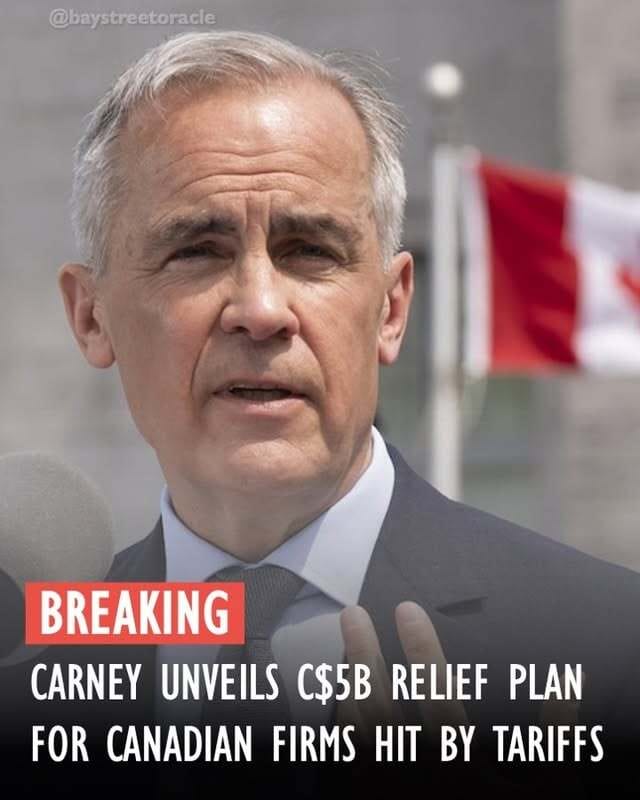
On Sept. 5, Prime Minister Mark Carney unveiled a C$5 billion fund for Canadian firms battered by tariffs, plus C$370 million for biofuels, new BDC loan facilities, and a reskilling program for 50,000 workers. Ottawa also launched a “Buy Canadian” procurement push — part industrial policy, part political signal.
The move came hours after bleak data: Canada’s jobless rate hit a four-year high, and trade with the U.S. and China remains gridlocked under Trump-era tariffs.


EV Rules on Ice
The relief followed a concession the night before. Ottawa shelved the 2026 EV mandate requiring 20% of new car sales to be zero-emission, bowing to automaker pressure. Industry leaders warned tariffs and weak consumer demand made the targets impossible. With federal subsidies already gone, June EV sales slid to just 8% of the total.

Steel, Aluminum, and the Tariff Wall
Algoma Steel shares have halved this year under 50% U.S. tariffs. Aluminum exports plunged 31% in July. Relief funds may soften the hit, but they don’t change the math of producing inside a tariff wall.

Side Voices

Wasn’t that always the case? Our auto sector’s been tied to Detroit for decades. At least have a little faith that Ottawa’s at least trying to keep the wheels on.
BSO’s Bottom Line
Carney is pivoting from Trudeau-era climate ambition toward survival economics. Bay Street will watch who gets the C$5 billion, but the bigger test is whether subsidies and procurement can offset the weight of tariffs. For workers, the question is starker: is this relief or just a pause before the next round of layoffs?
Overheard Down By the Bay
Jet set. WestJet placed the largest aircraft order in Canadian history — 60 Boeing 737-10 MAX jets and seven Dreamliners, with options for 29 more. Deliveries stretch to 2034, doubling its wide-body fleet and boosting aerospace jobs across Canada and the U.S. Full story here · Instagram breakdown here
Pour one out. And of course, Doug Ford. For those who haven’t seen: Ontario’s premier dumped an entire bottle of Crown Royal at a press conference this week, railing against Diageo’s decision to shutter its Amherstburg, Ont., bottling plant. Nearly 200 jobs will be lost when operations move to Quebec and the U.S. Ford’s message to the CEO in France: “You hurt my people. I’m going to hurt you.” Then he tipped the whisky onto the floor. Full story here

Coming Up Next
Conference circuit — Sept. 9. BMO’s Media & Telecom forum lands Tuesday (BCE on the docket), and bank chiefs hit Barclays’ Global Financial Services Conference the same day. National Bank’s Credigy COO Wallace Greene is slated for a morning slot. Expect fresh lines on margins, tariffs, and deal flow.
Canadian Club — Sept. 9–11. Scam-fighting panel (Rogers/RCMP/Scotiabank) Tuesday, then Bombardier CEO Éric Martel on Wednesday and Competition Commissioner Matthew Boswell Thursday. Airplanes and antitrust, back-to-back.
Data drops — Thu & next Tue. U.S. CPI hits Thursday, Sept. 11. Canada’s August CPI follows Tuesday, Sept. 16. Inflation prints set the tone into month-end.
Supervision watch — Sept. 11 & 25. OSFI’s Summer Quarterly Release day is Sept. 11, with an Industry Day on Sept. 25. Guidance and tone matter for bank capital and credit.
Get in Touch
Send tips, feedback, or story ideas: [email protected]
Or find us on Instagram: @baystreetoracle